
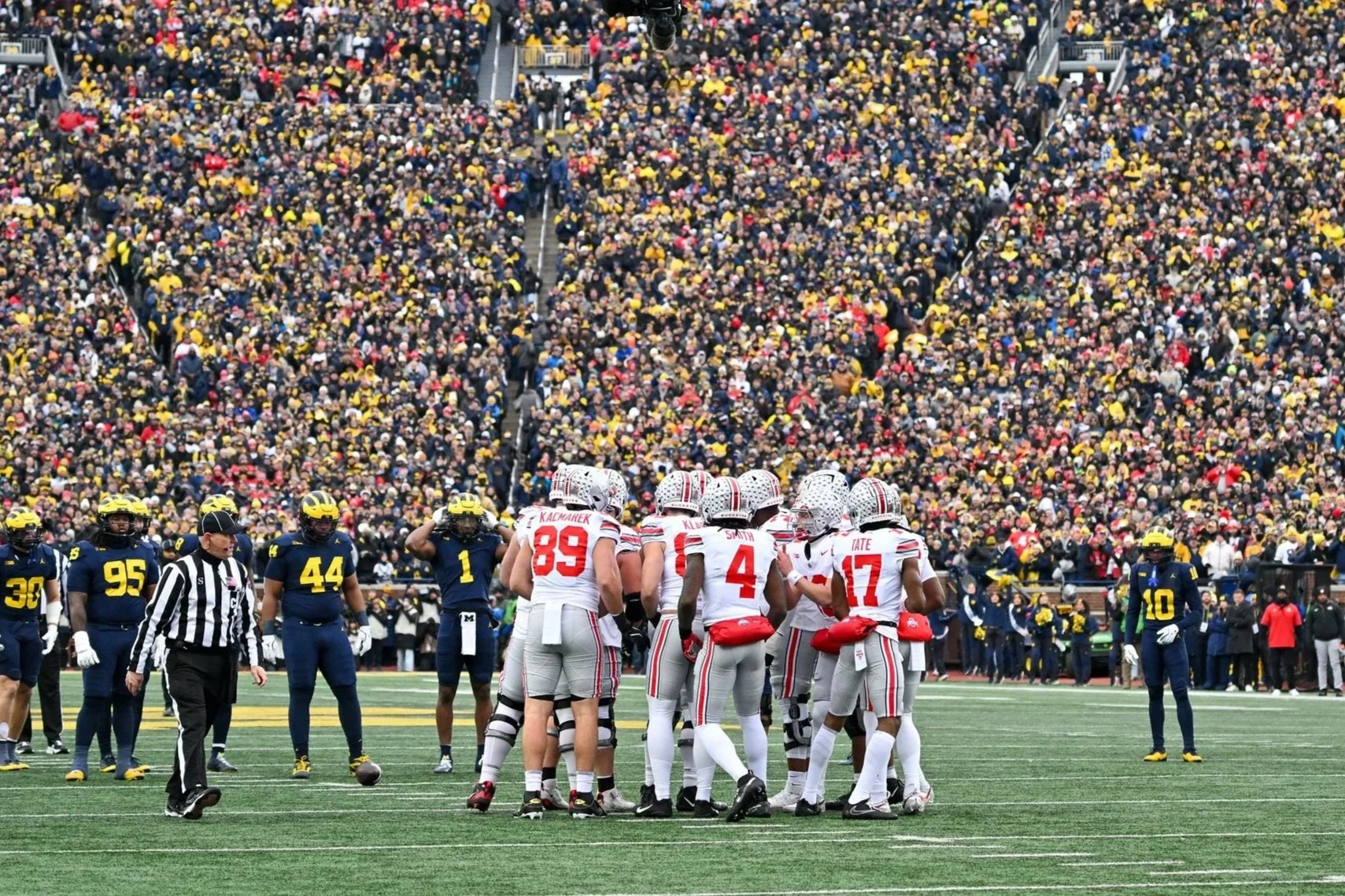
Photo by Brad muckenthaler(@muck_photo)A Brief History of “The Game”
By Casey Green
05/14/2026
The Ohio State Buckeyes and the Michigan Wolverines share one of the greatest rivalries in all of sports, let alone college football. Commonly referred to simply as “The Game,” the rivalry has consistently shaped the landscape of college football for more than a century.
The rivalry is historic, competitive, and annually one of the most important matchups in the sport. Ohio State and Michigan are the two winningest programs in college football history, with Michigan becoming the first program to surpass 1,000 all-time victories. While some fans argue rivalries such as the Iron Bowl rival this matchup, many still consider The Game to be the pinnacle of college football rivalries.
Starting with the basics, both programs play in stadiums that hold more than 100,000 fans. Michigan Stadium is the largest stadium in college football, while Ohio Stadium ranks among the largest in the nation as well. Both programs have won more than 73 percent of their games throughout their histories.
Combined, Ohio State and Michigan have claimed 21 national championships, 84 Big Ten championships, and produced 10 Heisman Trophy winners. Ohio State also produced the only two-time Heisman Trophy winner in college football history, Archie Griffin, who won the award in 1974 and 1975. These programs have consistently impacted the sport at the highest level, and that trend continues today, with Michigan winning the national championship in 2024 and Ohio State following with a title in 2025.
Another major reason this rivalry became so iconic is the legendary coaches involved throughout its history. Woody Hayes and Bo Schembechler helped elevate The Game nationally during their famous “Ten Year War” from 1969 to 1978. In the modern era, coaches such as Urban Meyer, Jim Harbaugh, Ryan Day, and Sherrone Moore have continued to keep both programs among the elite in college football.
The rivalry itself has produced some of the biggest games in college football history. The teams have met 27 times while both ranked inside the top 10, including 14 matchups where both programs were ranked in the top five nationally. Michigan currently holds the all-time series advantage at 62-56-6, although the rivalry has featured stretches of dominance from both sides throughout its history.
Outside of the canceled 2020 matchup during the COVID-19 pandemic, Michigan and Ohio State played every season from 1918 through 2019 — a streak of 102 consecutive meetings. Few rivalries in sports can match that level of consistency and tradition.
No matter the records entering the game, The Game consistently carries massive stakes and national attention. Year after year, the matchup remains one of the defining moments of the college football season.
Beyond college football, the rivalry has also produced an extraordinary amount of NFL talent. Combined, the two programs have produced 938 NFL Draft selections, including 155 first-round picks, 39 top-five selections, and five No. 1 overall picks. Both schools have consistently developed players who have left lasting impacts on professional football.
Each program has also produced 10 Pro Football Hall of Famers, with Tom Brady widely expected to join the Hall of Fame following his retirement eligibility. The level of talent generated by these two programs further solidifies their place among the most influential brands in football history.
Ohio State and Michigan have remained college football juggernauts for generations. While both programs have experienced occasional down years, neither has stayed away from national relevance for long. With two of the last three national championships belonging to these programs, the rivalry appears as strong as ever.
As college football continues to evolve through conference realignment, NIL, and the expanded 12-team playoff, The Game remains one of the sport’s defining traditions. Given its history, competitiveness, and continued national importance, Ohio State versus Michigan has a legitimate argument as the greatest rivalry in college football history.